Mechanisms & devices · 2021
Optical Fiber Coupling for Steerable Endoscopic Instruments
Coupling a surgical laser into a thinner optical fiber to enable tighter bending in steerable endoscopic probes.
Overview
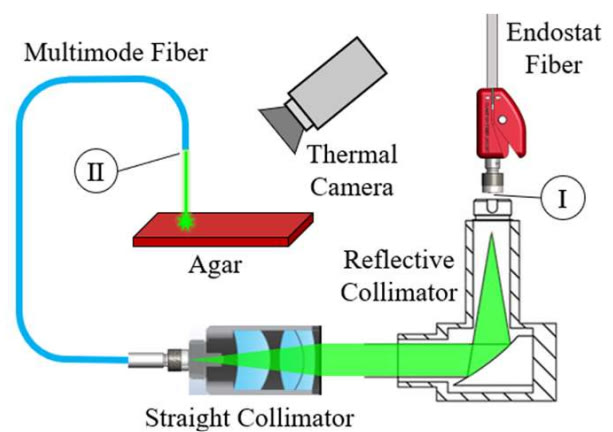
This project develops an optical coupling system that transfers light from a commercial surgical laser fiber into a thinner multimode fiber. The goal is to deliver laser energy through a steerable endoscopic probe in confined spaces, where a thick fiber limits the achievable bend.
The system couples a 400 µm Endostat fiber to a 200 µm multimode fiber using reflective and achromatic collimators. The thinner fiber enables a bending radius of approximately 6 mm, compared with a 12 mm minimum radius for the commercial fiber tested in the study.
Experimental characterization
Optical power measurements characterized the coupling performance across different laser power settings. The experiments achieved approximately 50% coupling efficiency, demonstrating that the smaller fiber could carry a substantial portion of the input laser energy.
Tissue ablation experiments used tissue-mimicking agar to test whether the transmitted energy remained sufficient for cutting. These benchtop results established the feasibility of the coupling approach for future steerable, fiber-based endoscopic instruments.
Design objective
By separating the laser-delivery interface from the flexible distal fiber, the system connects existing laser hardware with the bending requirements of a miniature steerable instrument. The work focuses on the optical and mechanical constraints of that connection.
Related publications
- Optical Fiber Coupling System for Steerable Endoscopic Instruments
IEEE EMBC · 2021